
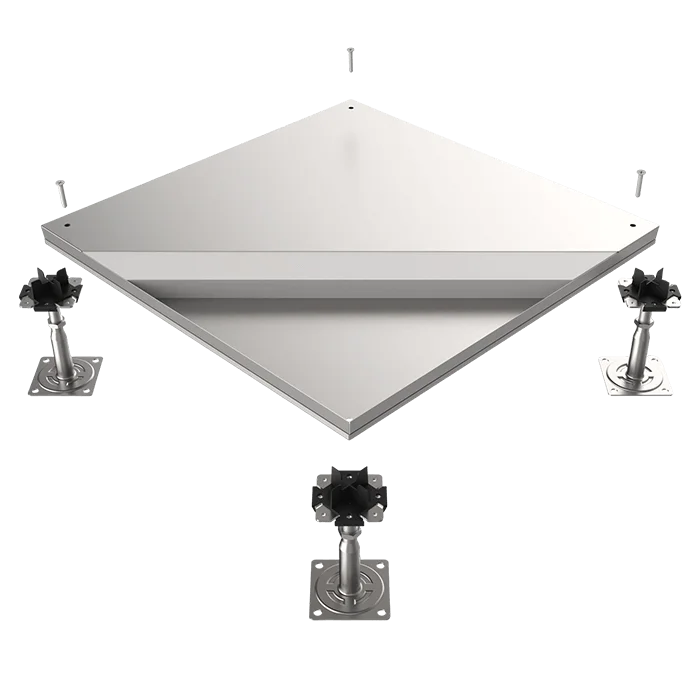
On the surface, the difference between an encapsulated calcium sulphate panel and a bare one is a thin layer of galvanized steel — roughly 0.5 mm on each face, and less than 2 mm across the edges. The cost difference between the two products is typically 12 to 18 percent, with the encapsulated version carrying the premium. The question that every procurement team and specification engineer must answer is whether that premium delivers proportional value, or whether bare calcium sulphate is adequate for the project's requirements.
The answer hinges on three factors: the environment the panel will operate in, the frequency of underfloor access, and the performance expectations over the building's intended service life. For some projects, the bare panel is the correct economic choice. For others, the encapsulated panel pays for itself within the first two years of operation. The data below supports both conclusions, depending on the project context.
The Performance Gap: What Encapsulation Changes
Bare calcium sulphate panels have been manufactured for over three decades and have an extensive track record in climate-controlled data centers throughout Europe and North America. When installed in environments where relative humidity is maintained between 40 and 55 percent — the standard operating range for most data centers — bare panels perform reliably for 15 to 20 years. The core material does not absorb significant moisture at these controlled levels, edge chipping is manageable with careful maintenance procedures, and the lifecycle cost is lower than any encapsulated alternative.
The performance gap emerges when conditions deviate from the controlled ideal. In tropical environments where RH routinely exceeds 70 percent, bare calcium sulphate absorbs moisture at 0.8 to 1.2 percent of panel weight annually. In industrial facilities where cutting fluids, steam, or process water introduce humidity fluctuations, the same absorption patterns degrade panel dimensions over time. In any building where underfloor access requires panels to be lifted more than six times per year — typical in high-churn office environments and some data center operations — edge and corner damage accumulates faster than bare panels can sustain without degradation.
The ESC raised access floor technology addresses every one of these failure modes directly. The galvanized steel shell eliminates moisture ingress entirely — zero measurable absorption in any environmental condition. The steel edges are rated for over 5,000 panel-lift cycles without damage, compared to 200 to 300 cycles before bare edges begin to chip. The steel corner wrap distributes impact loads so that corner breakage — the most common single cause of calcium sulphate panel replacement — is effectively eliminated.
Ten-Year Performance Comparison
| Metric | Bare CaSO₄ (Controlled Env.) | Bare CaSO₄ (Tropical/Industrial) | ECS Encapsulated |
|---|---|---|---|
| Panel replacement rate | 2 – 4% over 10 years | 12 – 18% over 10 years | < 1% over 10 years |
| Height deviation > 1.0 mm | 5% of panels at year 8 | 35% of panels at year 5 | < 2% of panels at year 10 |
| Plenum leakage increase | +12% from baseline | +28% from baseline | +3% from baseline |
| Edge damage (visible) | 8% of panels at year 7 | 22% of panels at year 4 | < 1% of panels at year 10 |
| Maintenance cost / m² / year | $1.20 – $1.80 | $2.80 – $4.50 | $0.40 – $0.80 |
The 15 Percent Premium: Where It Pays Back
A procurement team evaluating a 5,000 m² data center installation with a fifteen-year planning horizon faces the following arithmetic. The bare calcium sulphate panels cost $42 per square meter, totaling $210,000. The encapsulated panels at $49 per square meter total $245,000 — a premium of $35,000. Over fifteen years, the data center will experience approximately 120 maintenance events requiring panel lifts. In the bare panel installation, 12 to 18 percent of panels will sustain edge damage requiring replacement by year ten, at a cost of $18 to $27 per panel including labor. Plenum leakage from degraded panel edges will increase the cooling system runtime by an estimated 3 to 5 percent, adding $6,000 to $10,000 annually in electricity costs.
When these factors are modeled against the encapsulated alternative — where zero panel replacements are expected and the plenum integrity remains at 97 percent of baseline — the cost crossover occurs between year two and year three. After year three, ECS is the cheaper system. By year ten, the cumulative savings from avoided replacements and reduced cooling costs exceed the initial $35,000 premium by a factor of two to three.
When Bare Calcium Sulphate Is Still the Right Choice
Bare calcium sulphate retains a legitimate position in the specification ecosystem. For climate-controlled data centers in temperate climates with stable humidity, low maintenance access frequency, and a fifteen-year building life, bare panels deliver adequate performance at a lower first cost. For projects where the budget is the binding constraint and the environment is well understood and controlled, the bare panel is the correct selection. The calcium sulfate raised access floor in its bare form has served the industry well for decades and remains a viable product for the right project profile.
The mistake is selecting bare calcium sulphate for a project where the environment is uncontrolled, the access frequency is high, or the service life expectation exceeds twenty years. In those scenarios, the 12 to 18 percent premium for encapsulation is not a cost increase. It is an investment that generates a measurable return starting in year three and continuing for the life of the building. For specifiers evaluating Encapsulated Galvanized Steel Calcium Sulphate Raised Access Floor for a current or upcoming project, the question is not whether the premium is justified in absolute terms. The question is whether the project's conditions make bare calcium sulphate a risk that the premium eliminates.
